

Is shuttle becoming the new norm for mediation? It seems to becoming more frequent, and more often the starting assumption. This post asks why, and what shuttle costs in different kinds of matters.
What we are talking about
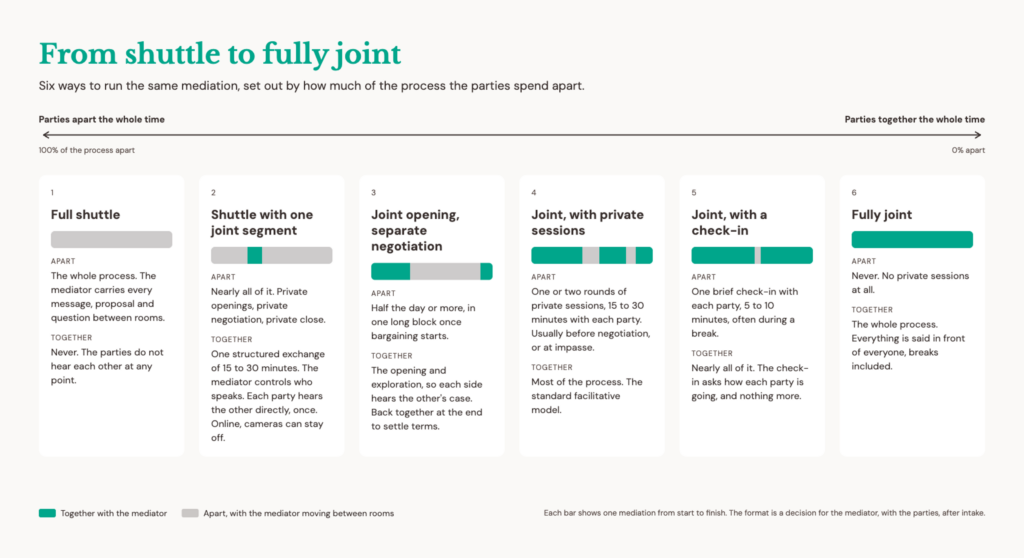
Shuttle mediation keeps the parties apart for the whole process. The mediator moves between rooms carrying information, proposals and questions. The parties never speak to each other.
That is different from a joint process that uses private sessions. Shuttle sits at the far end of that scale: one hundred per cent caucus.
Is it becoming more common?
I could not find Australian data, but in the United States the answer is yes, at least in legally represented civil work.
Folberg (2016) surveyed 205 mediators for JAMS. When they started practising, 80 per cent regularly began with a joint session. By 2016 it was 45 per cent. Galton, Love and Weiss (2021) surveyed International Academy of Mediators members. A quarter usually or always keep the parties apart for the whole mediation. They called the pattern “mediation without dialogue”.
Wissler and Hinshaw (2021) surveyed 1,065 mediators across eight states. Joint openings still happen in most cases: 71 per cent of civil and 64 per cent of family mediations. But in 47 per cent of civil cases there was no joint session of any kind, at any point. Where a joint opening did happen, parties often sat silent. In civil cases lawyers made opening statements in 71 per cent of joint sessions. Parties made one in 41 per cent.
The research found that criteria such as abuse, violence, prior litigation and non-money issues made little difference (Wissler and Hinshaw 2022). Three things did: lawyers, the mediator’s legal background, and the state the mediator practised in. When mediators said lawyers had the most influence over how the session began, 17 per cent of mediations opened jointly.

Five reasons it is spreading
Lawyers prefer it. In legally represented mediations, shuttle is normal and the lawyers usually want it. Their reasons are sound as far as they go. A lawyer can say hard things to a client in private. The mediator can reality test harder when the other side is not watching. Nobody says something in front of the other party that later becomes a problem. Garrison (2023), a former bank counsel turned mediator, adds that many lawyers came to see the joint session as a delay. Badly run joint sessions, he says, left parties “calcified in their positions”.
Referrers and panels are managing risk by avoiding it. A panel that directs shuttle for a category of matters has not assessed any of them. It has applied a rule. A rule is easier to defend than a judgement if something goes wrong. Instead of managing the risk, the rule avoids it, and a blanket response ignores the particular people involved. The decision has moved from the mediator, who will meet the parties and then design a process to fit, to an intake process that will not.
Online made it effortless. Before 2020, shuttle meant two rooms, a corridor and a lot of walking. Now it is a button. Many panels that were in person until COVID have never gone back. Online, nobody is in the same building. The physical safety argument for separation mostly disappears. The convenience argument gets stronger at the same time. We have made shuttle easiest in the setting where safety least requires it.
Parties ask for it. Lela Love’s summary of her survey data is blunt: “People in conflict are really angry at each other and they don’t want to see each other” (Love 2021). I think something else sits underneath. We communicate by text and email. Many people have lost the habit, and the confidence, of having any hard conversation in person, let alone ones about significant conflict. They imagine the worst: I will get angry, I will get confused, I will say something I do not mean. Shuttle promises none of that will happen.
There is also a quieter comfort in it. If I never have to face the other person, they can stay a faceless figure in another room making outrageous demands. Facing them means seeing a person, and that can feel like it undermines my position as the wronged party. Support people who sit through a shuttle for the first time often say afterwards that the other party never became a person.
It is easier for mediators. Managing two dysregulated people in one room is hard. Shuttle means we never have to. If the trend continues, newer mediators will get less practice at it, and the skill will go. AMDRAS lists shuttle among the “other” procedures a training course should cover. It sits alongside co-mediation (AMDRAS 2024, Appendix 1, para 13(b)). The standard assumes the joint process is what we train for, and shuttle is a variation. Practice may be heading the other way.

What it costs
The ABA Task Force found that outside labour-management disputes, caucus had no effect on settlement. It also had “a negative effect on disputants’ perceptions and post-mediation conflict”. Parties who spent more time in caucus were more likely to go back to court to enforce the agreement.
A Maryland court study (Charkoudian and colleagues 2016a) measured how much of each mediation happened in separate sessions. The higher the share, the more often parties said the mediator controlled the outcome. They said the mediator pressured them into a solution and stopped issues from coming out. They were less satisfied, less likely to call the outcome fair and workable, and more likely to feel powerless. Twelve months later they were more likely to be back in court for enforcement. The companion child access study (Charkoudian and colleagues 2016b) found the same pattern with parents. More time apart meant less belief that they could work with the other parent, and fewer ways they could see to resolve things.
Welton and colleagues found a cost as well. Caucus reduced hostility to the other party’s face and increased hostility behind their back. Parties used the private room to criticise the person who was not in it.
Two cautions. These are associations. Harder cases probably get more caucus, and harder cases probably have worse outcomes anyway. And the research is American, much of it from court-connected programs. We need Australian data and have none.
Even so, the pattern matches what many of us see in practice. In shuttle, the parties stop being the centre of the process. The mediator becomes the message. Someone else summarises, softens and delivers every statement. The party on the receiving end gets the mediator’s version of their former partner or business partner, and never the person.

The all-or-nothing problem
A directive that a matter will be shuttle treats shuttle as a switch. Most of the benefits it was reaching for come from private sessions, which any joint process can include. Most of the costs come from the parties never hearing each other at all. There is a lot of room between the two. A mediation can start apart and come together for one structured exchange. It can start together and separate.
If parties ask for shuttle because they are afraid of the conversation, the answer is to tell them what I will do about the fear. I will make sure you get to say what you need to say. I will make sure the other person listens, and I will check they understood. You will get to ask questions and I will ask them to answer. You can take a break whenever you want one. A joint mediation is the only setting in which the other party has to listen to you. The mediator relaying your words is a poor substitute.
Open questions
- When a referrer or panel directs shuttle, who assessed the matter, and what did they assess it against?
- In your own practice, what has to be true before you keep the parties apart for the whole process? Is that a rule or a judgement?
- How do you explain to a reluctant party what you will do to make the joint session safe, as distinct from what you will not do?
- If shuttle becomes the norm, where will the next generation of mediators learn to manage high conflict in a room?
- What would Australian data on caucus time and outcomes look like, and who could collect it?

References
- ABA Section of Dispute Resolution, Task Force on Research on Mediator Techniques (2017). Report of the Task Force on Research on Mediator Techniques. American Bar Association.
- ALRC (2010). Family Violence: Improving Legal Frameworks. Consultation Paper 1, ch 11. Australian Law Reform Commission.
- AMDRAS (2024). Australian Mediator and Dispute Resolution Accreditation Standards, Appendix 1 (Training and Assessment Framework), para 13(b).
- Charkoudian, L. (2016a). What Works in District Court Day of Trial Mediation: Effectiveness of Various Mediation Strategies on Short- and Long-Term Outcomes. Maryland Judiciary, Administrative Office of the Courts.
- Charkoudian, L. (2016b). What Works in Child Access Mediation: Effectiveness of Various Mediation Strategies on Custody Cases and Parents’ Ability to Work Together. Maryland Judiciary, Administrative Office of the Courts.
- Family Law (Family Dispute Resolution Practitioners) Regulations 2025 (Cth), s 20 (cited in the text as the FDR Practitioner Regulations 2025).
- Folberg, J. (2016). The shrinking joint session: survey results. Dispute Resolution Magazine, 22(2).
- Galton, E., Love, L.P. and Weiss, J. (2021). The decline of dialogue: the rise of caucus-only mediation and the disappearance of the joint session. Alternatives to the High Cost of Litigation, 39(6), 89.
- Garrison, P.E. (2023). In praise of the mediation joint session: an effective tool if you know how to use it. Daily Journal, 1 November 2023.
- Holtzworth-Munroe, A., Applegate, A.G., Beck, C.J., Rossi, F.S., Adams, J.M., Jiang, L.J., Tomlinson, C.S. and Hale, D.F. (2021). Intimate partner violence (IPV) and family dispute resolution: a randomized controlled trial comparing shuttle mediation, videoconferencing mediation, and litigation. Psychology, Public Policy, and Law, 27(4), 581–596.
- Love, L.P. (2021). Whither the joint session? Presentation to the CPR Institute, January 2021, reported in CPR Speaks.
- National Domestic and Family Violence Bench Book (2024). Section 10.2, Family dispute resolution. Australasian Institute of Judicial Administration.
- Pruitt, D.G., Peirce, R.S., McGillicuddy, N.B., Welton, G.L. and Castrianno, L.M. (1993). Long-term success in mediation. Law and Human Behavior, 17(3), 313–330.
- Roghanizad, M.M. and Bohns, V.K. (2017). Ask in person: you’re less persuasive than you think over email. Journal of Experimental Social Psychology, 69, 223–226.
- Rossi, F.S., Holtzworth-Munroe, A., Applegate, A.G., Beck, C.J., Adams, J.M. and Hale, D.F. (2017). Shuttle and online mediation: a review of available research and implications for separating couples reporting intimate partner violence or abuse. Family Court Review, 55(3).
- Welton, G.L., Pruitt, D.G. and McGillicuddy, N.B. (1988). The role of caucusing in community mediation. Journal of Conflict Resolution, 32(1), 181–202.
- Wissler, R.L. and Hinshaw, A. (2021). The initial mediation session: an empirical examination. Harvard Negotiation Law Review, 27(1).
- Wissler, R.L. and Hinshaw, A. (2022). Joint session or caucus? Factors related to how the initial mediation session begins. Ohio State Journal on Dispute Resolution, 37.