
You’ve received a referral from a workplace relating to performance, misconduct, bullying, or a disputed adjustment. Someone in the organisation will tell you the problem came out of nowhere. The employee was fine for six years, and then suddenly they were not coping. However, the reality is usually something that has accumulated over time and can be explained by a visibility loop.
This post is for two audiences. If you investigate, mediate or manage these disputes, the loop explains why the file in front of you often begins in the wrong place. If you run the organisation, it shows you which step you can change well before anything reaches a formal process.

Hostility to difference leads to masking
Most workplaces are set up to suit people who are broadly speaking neurotypical and from the dominant culture. When someone who is a bit different from the norm comes into the organisation, fitting in can be challenging.
In studies of neurodivergent employees, there is a common theme. Stand out and you will be discriminated against and bullied. Birkbeck’s research for Neurodiversity in Business identified that 65 per cent of neurodivergent employees feared discrimination from management if they disclosed their neurodivergence, and 55 per cent feared it from colleagues. One said: “In my previous workplace, I was less aware of my difficulties and therefore masked less and was bullied almost to extinction.” Another said the unwritten social expectations of the workplace are rigid, and deviation gets you bullied. A third put it simply: the more noticeable you are, the more open to bullying you are. The survey data agrees. One in five neurodivergent employees in the CIPD’s UK survey had experienced harassment or discrimination at work because of their neurodivergence.
One way to avoid discrimination and bullying is to try hard to fit in, even if that means behaving in a way that is unnatural to you and hard work. Masking means hiding your natural ways of moving, speaking and reacting. Instead, you work hard to behave the way that context treats as acceptable. For an autistic employee that might mean forcing eye contact that feels invasive. Holding still when your body wants to move. Rehearsing small talk in the car park. Copying the tone and phrasing of colleagues. Sitting through sensory pain in an open plan office without showing it. For an ADHD employee it might mean elaborate private systems that hide how much effort organisation takes. Or biting back the urge to interrupt. Or spending twice as long on each email so it reads as calm and linear.
Two clarifications before we go further.
First, masking is not lying. It is closer to what a visitor does in a foreign country with a phrasebook: constant, effortful translation, all day, and you never become fluent.
Second, everyone adapts at work. You speak to the CEO differently than to your friends. So what makes masking different? Pryke-Hobbes and colleagues surveyed 411 UK adults: autistic, otherwise neurodivergent, and neurotypical. All three groups reported masking at work. But the neurodivergent participants masked more, masked differently, and paid far more for it. A neurotypical worker polishes an existing self for the office. A masking neurodivergent worker constructs a second self, runs it all day, and does their job on what energy is left.
So masking hides the person from a workplace that punishes visible difference. It also keeps them in a job, in a labour market with a long record of excluding them. It also prevents anyone from noticing that they might need support and discourages disclosure from the person in need of adjustments. Masking is also exhausting and can lead to performance issues and eventually burnout.
The loop
The visibility loop shows that the root of the problem is hostility to difference. This encourages those who do not naturally fit in to mask. Masking prevents disclosure. Non-disclosure prevents adjustments. Without adjustments, performance suffers under the doubled load. Performance management arrives. The threat rises, so the masking deepens, until the mask collapses or a formal dispute occurs. By the time it reaches you, the file might say performance, misconduct, bullying, or a disputed adjustment. Underneath, it is often this loop, entered years earlier.
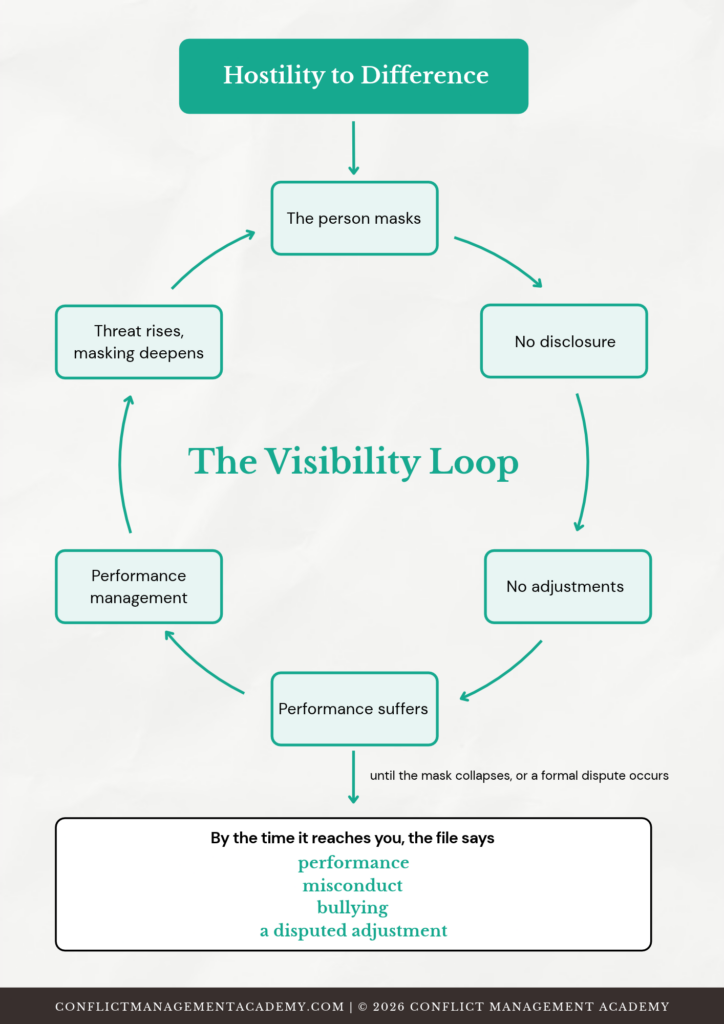
The visibility loop. The cycle can run for years before anything reaches a formal process.
A need must be visible to be addressed
When an employer only provides a flexible workplace for people with identified needs (e.g. due to a disability) and the culture punishes visible differences, we find ourselves in a catch-22 situation. An employer cannot adjust for a need it cannot see. The employee does not tell them what they need because disclosure is risky.
In the Neurodiversity in Business study, 69 per cent of employers said the absence of disclosure was their main barrier to making adjustments. Fewer than 30 per cent of the employees surveyed had formal adjustments in place.
Each side’s behaviour confirms the other’s problem. The employee will not disclose until the workplace is safe. The workplace doesn’t realise that it needs to show it is safe to someone it does not know needs it.
The Neurodiverse Safe Work Initiative calls this a recursive trap. The less safe disclosure feels, the less it happens. The less it happens, the easier it becomes to treat the consequences as performance problems. By the time the worker does disclose, the performance file already tells a story that is hard to undo.

What employers can do
Different exists – celebrate it
Every workplace carries a set of unwritten rules about what a competent colleague looks like. Eye contact of roughly the right length. Small talk on the way into the meeting. Visible enthusiasm. A tone that reads as warm rather than blunt. None of it is written down, none of it appears in a position description, and almost none of it is absolutely necessary to get the work done.
Start by separating what the job requires from the way the role is usually performed. Ask of any complaint whether it is about the work or about the manner. Missed deadlines, unilateral changes to scope and poor communication on shared projects are about the work itself, and they can be addressed on their own terms. However, lack of small talk, a flat delivery, no eye contact in the team meeting are complaints about cultural conformity.
Where the organisation has cultural requirements of employees, make them explicit. People who do not absorb them by osmosis are not helped by everyone pretending they do not exist. Explicit expectations, clear feedback and stated norms take a layer of guesswork away from everyone.
There is a method for doing this well. Brené Brown argues that values mean nothing until they are operationalised into observable behaviours, specific enough to teach and to hold people to. Simon Sinek makes the same point about the language: write them as verbs rather than nouns, because a verb describes something a person can actually do. Not “collaboration”, but the two or three things you mean by it.
Then, importantly, ask yourself whether you can justify this as a requirement of the work, rather than a preference about how the work looks? This is why guidance on neuroinclusive job advertisements warns employers off vague requirements like “strong communication skills” or “the ability to work in a team” and tells them to say what is actually needed or leave it out.
Birkbeck calls this neurodiversity gain. When an organisation redesigns how it works so that it suits neurodivergent people, the whole workforce benefits. In their 2026 data, being able to shape your own role, tasks and relationships was the strongest driver of engagement they measured, nearly four times more important than psychological safety.
Organisations need to actually walk the talk. When an organisation runs an awareness day, puts up a poster, and changes nothing about how meetings run or how performance is judged, the loop still continues.
Make flexibility the default rather than a reward for disclosure
Look at the adjustments your organisation has granted over the last two years. Flexible start times. A quieter desk. Noise cancelling headphones. Agendas circulated before the meeting and a written summary after it. Permission to keep the camera off. Then ask which of those would cause any harm if they were simply available to anyone who wanted them.
For most of the list the answer is none. Where an adjustment would help anyone who asked for it, requiring a diagnosis seems pointless and singles individuals out for ‘special’ treatment, which emphasises difference in a negative way. It also places all the responsibility on the individual rather than the organisation.
Kalmanovich-Cohen and Stanton argue that baseline support should not depend on disclosure at all, with flexible scheduling, quiet spaces and accessible communication available to anyone without having to give a reason. The Neurodiverse Safe Work Initiative makes the same point about the diagnose, disclose, prove, adjust model. It is reactive, it is individualised, and it puts all the risk on the worker.
This is not an argument for abolishing named adjustments. Some people may need something beyond the default for reasons connected to disability. A named adjustment is documented, agreed and legally protected, and when something later goes wrong it gives you the context to work out what happened.
However, in many cases, opening up flexibilities to everyone creates benefits for the organisation as a whole, not just the employee with a particular request.
Where disclosure is still needed, make it easier
Professor Amanda Kirby asked her LinkedIn audience whether they disclosed their neurodivergence at work in Neurodiversity 101: Reveal it all. Just over half said they sometimes disclosed, and that it depended. Her respondents described waiting for a signal from the employer before saying anything and not knowing what would happen next if they did.
Kirby also objects to the word disclosure itself, and she is right to. It implies something was being concealed. The person was managing a risk, not running a cover-up. Telling us what you need describes the same act without the accusation built into it.
Four things make disclosure easier:
1. Say what happens next, in writing. Who sees the information. What it is used for, and what it will never be used for. Where it is stored. Whether it follows the person when they change roles. Most policies are silent on all five, and silence reads as risk.
2. Separate the support conversation from the performance conversation. Where the only reliable route to an adjustment runs through a performance process, disclosure will always be reactive and will always look tactical.
3. Train the managers. In Birkbeck’s 2023 research, employers named the absence of disclosure as their main barrier. By the 2026 report, they described the main challenge as lack of manager understanding, named by 64 per cent of employers.
4. Let senior people go first. Kirby’s respondents described leaders talking about their own neurodivergence as the thing that changed what everyone else believed would happen to a person who became visible. Psychological safety is the strongest protector against burnout in the Birkbeck data, and the largest single driver of career satisfaction. It has not improved across three years of the survey.

What practitioners can do
Four things follow for practitioners.
1. Assume the person in front of you may be masking. Your process is a workplace too, with its own unwritten rules. A party who presents as calm and agreeable may be spending everything they have on that presentation. That leaves nothing for the conversation. Composure is not evidence of capacity, and agreement given under that level of masking may not be reliable.
2. Expect inconsistency and be careful what you read into it. A masking person performs differently in different settings. They may be polished in a formal interview but struggle on the floor. They might be articulate in writing but halting in a confrontation. Investigations often treat that variation as proof of exaggeration. However, context dependence is often a sign of masking, not of faking.
3. Treat a diagnosis or disclosure that arrives mid-dispute as information rather than tactics. An employee may go on a performance plan and only then disclose or seek assessment. Employers usually read this as an excuse produced under pressure. What often happened is that the threat of losing the job finally made disclosure a better choice than continued masking.
4. Enquire about the reasons for non-disclosure but ask in a way that doesn’t imply blame. So instead of asking “Why didn’t you tell us?”, ask “What made it unsafe to disclose, and what would change that?”
References
Ali, D., Bougoure, M., Cooper, B., Quinton, A. M. G., Tan, D., Brett, J., Mandy, W., Maybery, M., Magiati, I., & Happé, F. (2025). Burnout as experienced by autistic people: A systematic review. Clinical Psychology Review, 122, 102669. https://doi.org/10.1016/j.cpr.2025.102669
Brown, B. (n.d.). Operationalizing your organization’s values. Dare to Lead Hub. https://brenebrown.com/operationalizing-your-orgs-values/
CIPD. (2024). Neuroinclusion at work report 2024. Chartered Institute of Personnel and Development. https://www.cipd.org/globalassets/media/knowledge/knowledge-hub/reports/2024-pdfs/2024-neuroinclusion-at-work-report-8545.pdf
Employer Assistance and Resource Network on Disability Inclusion. (n.d.). Including neurodivergent workers: Job descriptions and interviewing. AskEARN. https://askearn.org/page/neurodiversity-job-descriptions-and-interviewing
Higgins, J. M., Arnold, S. R. C., Weise, J., Pellicano, E., & Trollor, J. N. (2021). Defining autistic burnout through experts by lived experience: Grounded Delphi method investigating #AutisticBurnout. Autism, 25(8), 2356-2369. https://doi.org/10.1177/13623613211019858
Kalmanovich-Cohen, H., & Stanton, S. J. (2025). Moving beyond disclosure: Rethinking universal support for neurodivergent employees. Frontiers in Psychology, 16, Article 1547877. https://doi.org/10.3389/fpsyg.2025.1547877
Kirby, A. (2024, October 23). Neurodiversity 101: Reveal it all, is disclosure a good idea or not? LinkedIn. https://www.linkedin.com/pulse/neurodiversity-101-reveal-all-good-idea-kirby-mbbs-mrcgp-phd-fcgi-chcae/
Koldas, M., Dounavi, K., MacCarthaigh, M., & Dillenburger, K. (2025). Facilitators and barriers to employment of neurodivergent individuals: A systematic literature review of employee and employer experiences. Journal of Autism and Developmental Disorders. Advance online publication. https://doi.org/10.1007/s10803-025-07139-6
Lee, C. (2026, February 19). Why traditional disability employment practices are failing neurodivergent workers. Neurodiverse Safe Work Initiative. https://neurodiversesafework.com.au/why-traditional-disability-employment-practices-are-failing-neurodivergent-workers/
McDowall, A., Doyle, N., & Kiseleva, M. (2023). Neurodiversity at work 2023: Demand, supply and a gap analysis. Birkbeck, University of London / Neurodiversity in Business. https://neurodiversity.org/wp-content/uploads/2023-11-08_NiB_BKK_Neurodiversity-in-Business-Report-2023.pdf
McDowall, A., & Srinivasan, A. (2026). Neurodiversity in Business: Research report 2026. Neurodiversity gain, inclusive practice and self-employment. Birkbeck, University of London / Neurodiversity in Business. https://neurodiversity.org/wp-content/uploads/2026/07/Neurodiversity_in_Business_Birbeck_Research_Report_2026.pdf
Praslova, L. (n.d.). Workplace bullying of autistic people: A vicious cycle. Specialisterne USA. https://us.specialisterne.com/workplace-bullying-of-autistic-people-a-vicious-cycle/
Pryke-Hobbes, A., Davies, J., Heasman, B., Livesey, A., Walker, A., Pellicano, E., & Remington, A. (2023). The workplace masking experiences of autistic, non-autistic neurodivergent and neurotypical adults in the UK. PLOS ONE, 18(9), e0290001. https://doi.org/10.1371/journal.pone.0290001
Raymaker, D. M., Teo, A. R., Steckler, N. A., Lentz, B., Scharer, M., Delos Santos, A., Kapp, S. K., Hunter, M., Joyce, A., & Nicolaidis, C. (2020). Having all of your internal resources exhausted beyond measure and being left with no clean-up crew: Defining autistic burnout. Autism in Adulthood, 2(2), 132-143. https://doi.org/10.1089/aut.2019.0079
Sinek, S. (n.d.). What should your company culture be? Start with verbs. Big Think. https://bigthink143. https://doi.org/10.1089/aut.2019.0079
Some questions to sit with
- When you say “confidential” to a client, which of the variables above are you actually promising, and which are you leaving them to assume?
- In the settings you work in, what remedy would a client realistically have if the other party breached? If the honest answer is none, does your language reflect that?
- If your mediation sits under a statutory scheme, could you explain to a party, in one sentence, how that protection might be lost?
- How might you turn the confidentiality conversation into a discussion about purpose, rather than a blanket assurance?
Additional reading
- Flip About Pty Ltd v Alamdo Holdings Pty Ltd [2026] NSWSC 431.
- Bobette Wolski (2020) Confidentiality and privilege in mediation: concepts in need of better regulation and explanation. UNSW Law Journal 43(4) 1552 to 1594.
- Rachael Field and Neal Wood (2005) Marketing mediation ethically: the case of confidentiality. QUT Law Review 5(2) 143 to 159.