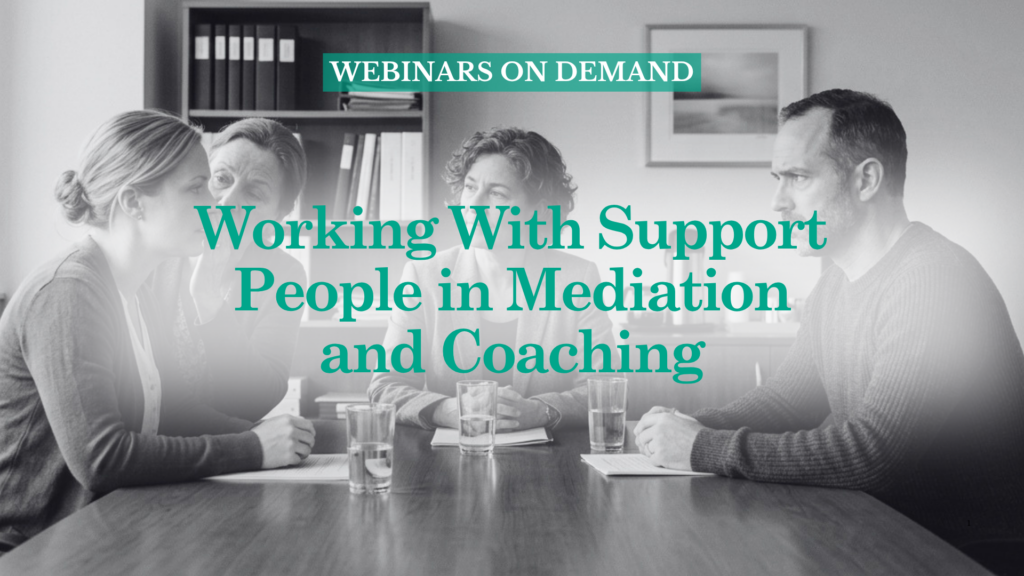
An extra person in the room: Support People in Conflict Resolution Processes
Rethinking how we approach support people in mediation and conflict coaching
There is a moment most experienced practitioners will recognise. You have carefully prepared both parties, established ground rules, and begun building the conditions for a productive conversation. Then someone mentions, almost as an aside, that they would like to bring a support person.
“The request seems simple enough. It rarely is.”
INTRODUCTION SECTION
Support people are one of the least examined aspects of mediation practice.
The field has clear frameworks for opening statements, for shuttle mediation, for reality testing and reframing. But when it comes to having a support person in the room, most practitioners are left relying on instinct, organisational policy, or a blanket rule that may or may not fit the situation in front of them.
Drawing on a review of published guidance across Australia, New Zealand, the UK and the United States, practitioner experience, and Dr Olivia Rundle’s research on participation models in mediation, this session offers a structured framework for thinking about support people across the full range of conflict resolution contexts, including conflict coaching, where the question arises differently and is almost never addressed.
WHAT YOU WILL EXPLORE
Why parties request support people, and what self-determination actually requires
The full range of people who appear in support roles, including the growing category of professional support persons
An adapted version of Rundle's five-model framework for defining and agreeing on support person roles before the session begins
What published guidance across multiple jurisdictions says, and where it falls short of what practitioners actually need
Six concrete recommendations for better individual and organisational practice
The specific complications that arise in conflict coaching, and why the default question is different
How cultural and community contexts change the picture, and why the silent observer model is not a universal standard
THE GAP THIS WEBINAR ADDRESSES
A review of publicly available support person policies from Legal Aid Queensland, Victoria Legal Aid, the Dispute Settlement Centre of Victoria, NSW and NT Community Justice Centres, the New Zealand Dispute Resolution Centre, the Resolution Institute, and the US Equal Employment Opportunity Commission found one thing strikingly consistent: the silent observer model is the ceiling that published guidance has set.
Yet practitioners are managing support people who take active roles, advocate for parties, provide professional expertise, and operate across a range of cultural contexts where silent presence is neither expected nor appropriate.
The gap between what the guidance says and what practitioners are actually navigating is significant.
WHO THIS IS FOR
This webinar is designed for practising mediators, family dispute resolution practitioners, conflict coaches, and in-house dispute resolution specialists at any stage of their career.
It will be particularly useful if you have ever:
Applied a blanket rule about support people and felt uncertain whether it served the parties
Faced a request from a party to bring a support person whose role was unclear or contested
Worked with a professional support person and been unsure where the role boundaries sit
Found that published guidance gave you the power to act but not the framework to act well
Wondered whether the same questions apply differently in coaching than in mediation
No prior knowledge of Rundle’s framework is required. Everything is covered in the session.
WHAT YOU WILL TAKE AWAY
1
A five-model role framework you can use immediately to structure conversations with parties and support people before the session begins
2
A disclosure standard for deciding what the other party needs to know, and why
3
A structured set of questions to ask yourself, the party, the prospective support person, and the other party at each stage of the process
4
Six specific recommendations for improving individual practice and organisational policy
5
A clearer sense of where the coaching context requires a different default, and why
About your trainer:
Dr Samantha Hardy is the Director and Lead Trainer for The Conflict Management Academy. She is an experienced mediator and conflict coach and the founder of the REAL Conflict Coaching System™. She provides conflict support to managers and leaders across the world. She also provides professional development training, supervision and mentorship to mediators and coaches who work with clients in conflict.
Sam is accredited under the Australian Mediation and Dispute Resolver Accreditation System and is a Certified Transformative Mediator by the US Institute of Conflict Transformation. She is a Certified Narrative Coach. In 2021 Sam was awarded the Australian Resolution Institute Award for Service to Dispute Resolution for her leadership and innovation in the field. She was also awarded 2022 Conflict Coach of the Year at the Australian Dispute Resolution Awards.
RELATED RESOURCE
Working with Lawyers in Mediation Presented by Dr Olivia Rundle
Dr Rundle’s research on how lawyers participate in mediation forms the foundation of the role framework used in this webinar. Her webinar on working with lawyers in mediation is available on demand through the Conflict Management Academy and pairs well with this session.